
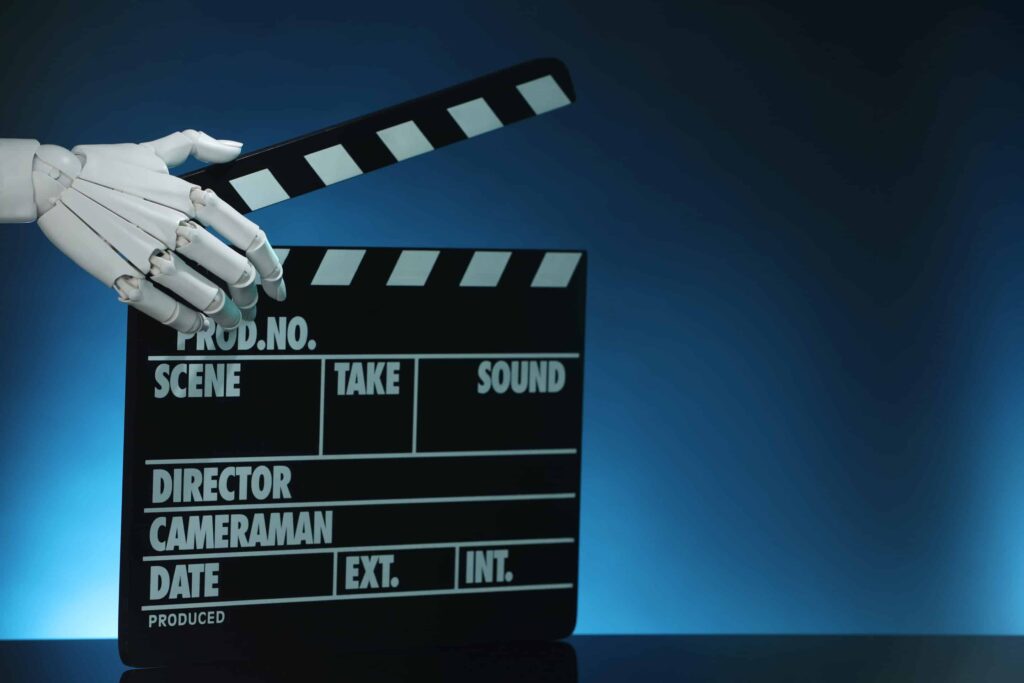
AI is on the rise in video production. What was once niche software is now a major trend in video marketing and production. From social media content to AI-generated commercials, there’s no escaping this technology anytime soon.
But the question remains: Is it really all that special, or is it actually harmful to the industry? Let’s explore both the benefits and the drawbacks of AI in video production. Whether you love it or hate it, here’s what you need to know to move forward in this technology-driven world.
What is AI in Video Production? 5 Ways it Can Be Used
There’s no denying that AI can benefit the video production process. Here’s how creatives can use it for a seamless final product:
1. Video & Audio Editing
AI tools can significantly reduce editing time in the studio. From suggesting edits to assembling rough cuts, AI can be your own editing assistant.
Here are just a few video and audio editing tasks AI-assisted tools can perform:
- Eliminate human mistakes, such as a wobbly camera or an awkward pause in dialogue
- Analyze color balance, lighting conditions, and saturation to perform color correction and craft a vibrant video
- Remove unwanted background noise
- Balance sound levels across clips for consistency
- Suggest a stellar soundtrack that’s perfect for your video
- Enable cloud editing so your team can work on the same project simultaneously, no matter where they are in the world
Bottom line: AI tools can significantly reduce editing time and help craft a polished final product without sacrificing quality.
2. Script & Voice Generation
If you’re having writer’s block or don’t want to record another voiceover, AI tools can do the work for you. AI-driven tools can create storyboards and scripts from your prompt, ideas, or rough outlines in a matter of seconds. You can plug in structure, suggested tone, and audience intent to end up with a script that’s perfect for your project. Text-to-speech (TTS) technology can also help create human-like voiceovers for written scripts, allowing you to produce narration without doing it yourself or hiring someone. Or if you look over a video and wish it were phrased differently, these AI tools can go in and tweak it at the touch of a button. AI tools can even create captions for your video, replacing manual transcription with time-synced subtitles within minutes.3. AI Avatars
Some software can create AI-generated avatars or virtual characters that can deliver scripted content in various languages. These AI avatars can be used for employee training videos, lectures, explainer content, internal communication, and more. If you don’t have the budget to hire actors or don’t have the time to get your team in front of the camera, these virtual characters could save time and money.4. Automated Metadata Tagging
AI in video production can automatically detect objects, faces, locations, and dialogue, then add descriptive labels to footage for easier organization and search. If you’re tired of scouring through hours of footage to add metadata tags manually, AI tools can now log them in seconds.5. Scene Detection
AI-powered tools can automatically identify scene changes, camera cuts, and visual transitions within your footage. Instead of manually scrubbing through video content to mark new segments, AI can detect and divide scenes in seconds, making editing, organizing, and locating specific moments faster and more efficient.How Does AI in Video Production Fall Short?
Those benefits sound pretty great, right? But let’s do a bit of a reality check. Before you use AI for everything in your next project, keep these shortcomings in mind:It’s not a magic button that fixes everything.
Nowadays, it’s common to hear something along the lines of “I’m sure AI can fix that,” especially in video production, where efficiency is at the forefront of many minds. However, this is a dangerous thought process, mainly since AI-assisted tools don’t always produce consistent results. Even with AI, videos still need to be reviewed by humans to ensure they align with the vision.
Sure, AI software can streamline tasks and reduce production costs, but it can’t replace creativity and years of industry experience. There’s massive thought that goes into video production, whether you’re crafting a commercial or the next blockbuster hit—there’s no way AI can capture everything or fix it all so it’s a cohesive project that brings your idea to life. Video production requires teamwork, problem-solving, and going back to the drawing board over and over again, which AI-assisted tools can’t replicate.
Even if you were to use complete AI in video production, your audience would most likely detect it, and you’d probably receive significant backlash (more on that later). The bottom line is that AI can contribute to video production, but can’t and shouldn’t completely take over the process. It has limitations, and it lacks a human touch that can be felt on the screen.
There are some ethical and legal concerns.
The one big question swirling around right now is: “If AI generates a significant portion of video content, who actually owns it?” And the answer right now is: we’re not sure. There are major disputes over copyright and AI happening right now, especially in creative industries, with no clear answer.
The use of AI in video production raises ethical questions about transparency and accountability. If AI is used to create educational content or make decisions, it’s unclear who’s held responsible if something goes wrong. Additionally, AI-assisted tools are trained by whoever’s inputting the data. As a result, AI-generated content can be unintentionally biased if the training data reflects limited perspectives, outdated information, or systemic inequalities. Without careful oversight and diverse data inputs, those biases can be reinforced and scaled—sometimes without users even realizing it.
Its output can be generic and turn off the audience.
If you want to create videos that stick, it’s probably not the best idea to let AI generate or handle the entire project. The question, “Wait, was that AI or real?” is increasingly common today, leading to growing distrust between companies, creatives, and their audiences. Viewers have become more cautious about visual content that even remotely resembles AI. And the first thing they notice? How generic and emotionless AI-assisted content can feel.
Complete AI-generated content is drawn from the same datasets, resulting in outputs that feel recycled versions of what’s been done before. There’s a tangible lack of originality that feels predictable, bland, and the opposite of inspiring. To be clear, we’re not talking about video content that’s created with the assistance of AI—we’re talking about content that’s generated entirely by AI, without the direction, nuance, and emotional insight that human creatives bring to the table.
One example of how AI-generated content can turn off an audience immediately is Coca-Cola’s 2025 holiday ad, “Holidays Are Coming.” What was meant to be a warm, nostalgic callback to their 1995 commercial of the same name became a generic, cold ad that many critics called “soulless.” The ad features overly polished animals, random shots stitched together with no cohesion, and a lack of human warmth that marks the holiday season. The ad sparked major conversations about the overreliance on AI in video production rather than hiring people to do the job and produce work that actually feels like something.
It lacks human-backed creativity.
The biggest downside of AI in video production is that it lacks lived experience. It doesn’t carry the intentional storytelling, emotional intuition, and cultural context that shape truly meaningful work. While it can save time and cut costs, it can’t replace the perspective, empathy, and creative instincts that human storytellers bring to every project. Great video content isn’t just assembled—it’s felt. It’s built from personal experiences, creative risks, and an understanding of how stories resonate with real people. AI can mimic patterns, but it can’t replicate the depth, originality, and emotional nuance that come from being human.How to Properly Leverage AI in Video Production
AI isn’t going anywhere, so how can you use it in video production? Keep this in mind: it’s a tool, not a replacement meant to be solely responsible for creating your next project. Used intentionally, AI-driven tools can help streamline workflows, reduce costs, and overcome creative blocks. However, if they’re misused or over-relied on, they can create generic content that feels lifeless to the audience. AI excels at efficiency, but it doesn’t meet the demand for impactful storytelling and emotional resonance. That job remains in the hands of humans with years of experience and a passion for telling stories.When AI Falls Short, Partner With a Human-Led Production Company
If you’re concerned about the growing dependence on AI in video production, it may be time to partner with a team that puts human creativity first. At Avalanche Studios, we create visual content that feels undeniably human. Our team of award-winning creatives, writers, and filmmakers dedicates time and energy to your project idea. We’ll sit down with you to hear your vision, craft content that matches it, and edit it seamlessly for a final, stunning product.
When you work with us, you’ll create a video project that resonates deeply with viewers and tells a story no AI-driven tool could match. Request a quote from our team to see how we can bring your project to life.